Where to find it
Blackberry is probably Britain’s best-known wild food.
The plant itself is bramble: a vigorous scrambling shrub found in hedges, woodland edges, scrub, neglected ground, railway margins, footpath edges and gardens.
Long arching stems — appropriately known as canes — carry hooked prickles. When a cane touches the ground it can take root at its tip, allowing an apparently modest plant to become an enormous thicket.
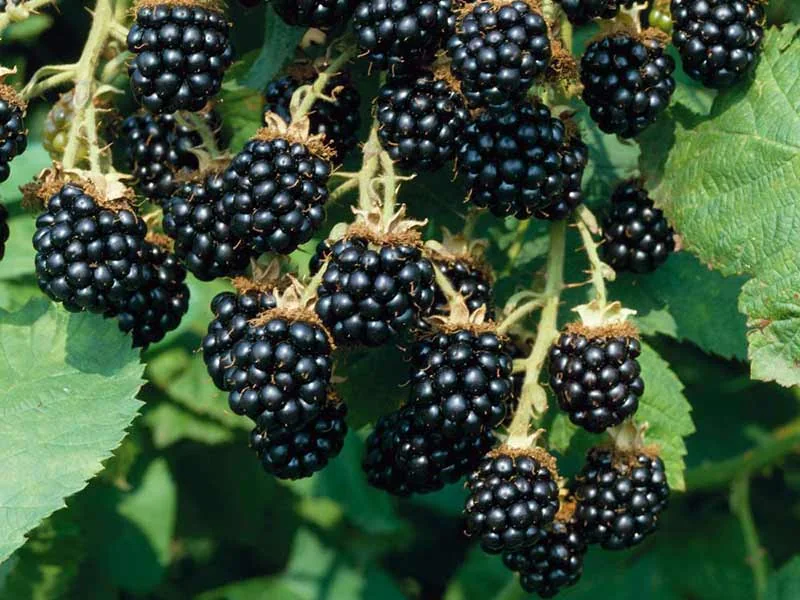
White or pinkish flowers develop into clusters of fruit. Individual fruits begin green, turn red and finally become deep purple-black as they ripen.
Blackberries can start ripening from July and continue through late summer into autumn.
What can be eaten?
The ripe berries are the obvious prize and can be eaten directly from the bush after washing.
They freeze remarkably well and can be used in crumbles, pies, vinegar, cordials, wine, fruit leather, sauce, jelly and jam.
Young bramble leaves are edible too. They have traditionally been infused to make a tea, although the leaves are astringent and can leave a distinctly drying sensation in the mouth.
When is a blackberry ripe?
Look for plump, dark purple-black fruit that releases relatively easily when picked. Hard red fruit is unripe.
Taste varies enormously between bramble patches. Britain has a bewildering number of closely related bramble forms, so one hedge can produce remarkably sweet berries while another fifty metres away produces fruit sharp enough to make your face fold itself in half.
Classic preserve
Blackberry and apple jam
Blackberries and cooking apples are a particularly useful combination because apple contributes acidity and pectin as well as flavour.
- 500 g blackberries
- 2 medium cooking apples, peeled, cored and chopped
- 500 g granulated or preserving sugar
- Juice of 1 large lemon
Put a small saucer in the freezer before starting.
Place the apples, blackberries and lemon juice in a preserving pan. Add a small splash of water if necessary to prevent sticking. Cook gently until the fruit is completely soft.
Add the sugar and heat gently until it has dissolved. Bring to a rolling boil, stirring carefully, until setting point is reached.
Test by dropping a small amount onto the cold saucer. Leave it briefly, then push it with a fingertip. If the surface wrinkles, the jam is approaching its set.
Transfer to clean, properly sterilised jars while hot and seal appropriately.
Seedless alternative: bramble jelly
If someone dislikes blackberry seeds, cook the berries with some apple and water, strain the juice overnight through muslin, then boil the resulting liquid with preserving sugar.
Warning
The fruit is friendly. The plant very much isn’t.
Bramble canes have hooked thorns/prickles capable of scratching hands and arms and snagging clothing. Long sleeves are sensible when reaching into a large patch.
Avoid fruit immediately beside busy roads and don’t take every ripe berry. Blackberries are an important late-summer food for numerous birds and mammals.
Wash fruit carefully before use.