
0
Surface sow
Press tiny seed onto moist compost without burying it. Keep good contact with the surface and avoid washing it into the compost when watering.
Sowing & propagation
A practical reference for when to sow, how deeply to plant, when cold treatment helps, and how to get young plants safely established.
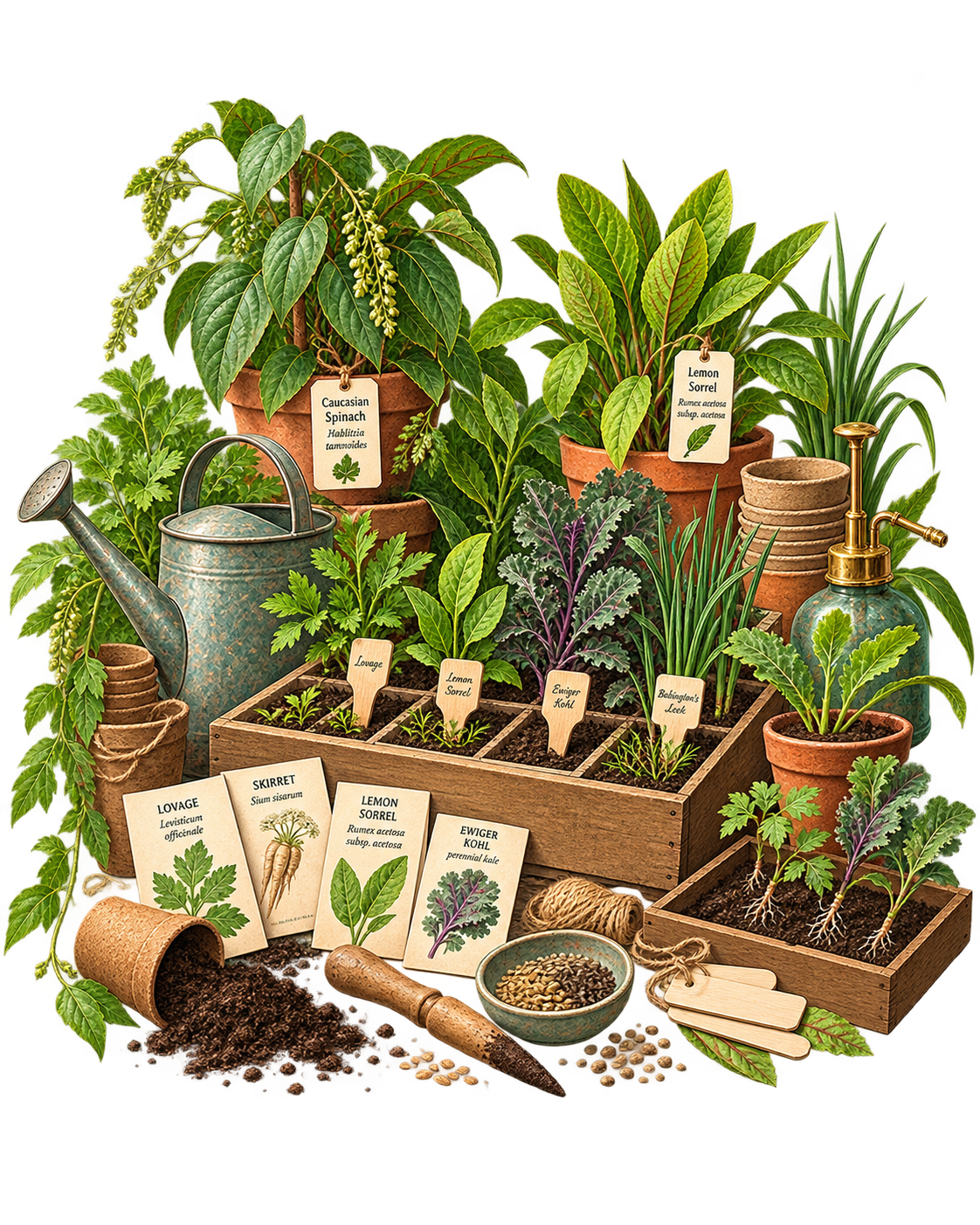
Start here
The table gives the quickest answer: find the plant, check whether it needs cold treatment, note the sowing depth and use the timing as your starting point. Where the plant has a catalogue page, click its name to jump straight to that plant’s growing and propagation section.
| Plant | Stratification | Depth | When to sow |
|---|---|---|---|
| Alexanders | Yes | 1 cm | Sow Oct–Nov, germinates spring |
| Angelica | Yes | 0.5 cm | Sow Oct–Nov, sprouts Mar–Apr |
| Babington’s Leek | No (bulbils) | 1–2 cm if seed | Sow Mar–Apr; bulbils Mar |
| Bistort | No | 3 mm | Sow Dec–Feb and sow Feb–Apr |
| Caucasian Spinach | Yes | 0.5 cm | Sow Oct–Nov, slow may take until Apr–May |
| Celtuce | No | 0.5 cm | Sow Apr–May |
| Chervil | No | 5 mm | Sow Feb–Mar & Aug–Sep |
| Chickweed | No | Surface/0.5 cm | Sow Feb–Apr (self-seeds after) |
| Chicory | No | 10 mm | Sow Mar–Apr; direct Apr–Aug |
| Chinese onion chive | No | 10 mm | Sow Mar–Apr |
| Cinnamon Basil | No | 1–2 mm | Sow May–Jun |
| English Plantain | No | Surface/0.5 cm | Sow Mar–Apr |
| Ewiger Kohl | No (cuttings) | – | Propagate cuttings Mar–Apr |
| Good King Henry | Yes | 1 cm | Sow Oct–Nov, germinates spring |
| Jerusalem Artichokes | No (tubers) | 10–15 cm | Plant Mar–Apr |
| Lamb’s Quarters | No | Surface/0.5 cm | Sow Mar–Apr |
| Lemon Balm | No | Surface/0.5 cm | Sow Mar–Apr (spreads easily) |
| Lemon Sorrel | No | 0.5 cm | Sow Mar–Apr |
| Lovage | Yes | 0.5 cm | Sow Oct–Nov, sprouts Mar–Apr |
| Mangelwurzel Ursus Poly | No | 2–3 cm | Sow Apr–May |
| Meadowsweet | Yes | Surface/light dust | Sow Oct–Nov, sprouts Mar–Apr |
| Oca | No (tubers) | 5–7 cm | Plant Apr–May |
| Purple Orach | No | 10 mm | Sow Feb–Mar; direct Apr–Aug |
| Purslane | No | Surface/0.5 cm | Sow Apr–May (warmth needed) |
| Red Amaranthus | No | 0.5 cm | Sow Apr–May (needs warmth) |
| Rosemary | No | 5 mm | Sow Feb–Apr with warmth |
| Salad Burnet | No | 0.5 cm | Sow Mar–Apr |
| Salsify | No | 1.5–2 cm | Sow Mar–Apr (direct) |
| Scorzonera | No | 1.5–2 cm | Sow Mar–Apr (direct trays or beds) |
| Sculpit | No | 0.5 cm | Sow Mar–Apr |
| Sea Kale | Yes | 1.5–2 cm | Sow Oct–Nov, sprouts spring |
| Silverweed | Optional | 0.5 cm | Sow Oct–Nov, germinates spring |
| Skirret | Optional | 0.5 cm | Sow Oct–Nov, germinates spring |
| Strawberry Spinach | No | 5 mm | Sow Feb–Apr; direct Apr–Jun |
| Thyme | No | 2 mm | Sow Feb–Apr |
| Tiger Nuts (Chufa) | No (tubers) | 5–7 cm | Plant Apr–May (after frost) |
| Victorian Dwarf Pea | No | 3–5 cm | Sow Feb–Apr in trays or direct |
| Wild Garlic | No | 10 mm | Sow Nov–Jan |
| Yarrow | Optional | 2 mm | Sow Feb–Apr or Aug–Sep |
The bit that catches people out
Unusual seeds vary enormously in size. Treat the depth in the table as the plant-specific instruction; these four groups explain what those depths mean in practice.
Press tiny seed onto moist compost without burying it. Keep good contact with the surface and avoid washing it into the compost when watering.
Use only a very fine dusting of compost or vermiculite. The seed should be protected from drying without being buried deeply.
For the many entries around 0.5–1 cm, make a shallow depression or drill, sow evenly and cover gently before watering.
Larger seeds and planting material can sit deeper. Firm the compost or soil back around them so there are no large air gaps.
Cold stratification
Some perennial seeds are adapted to experience winter before they germinate. Others do not need it at all, so cold treatment should be used because the plant calls for it — not as a blanket rule.
Use pots, modules or a protected seed bed with free-draining compost.
Keep it outside or in an unheated protected area where it experiences winter conditions without becoming waterlogged.
Some seeds sit apparently dormant for months and only move once conditions change in spring.
Do not let small pots dry completely just as germination begins.
The aim is cool and moist, never soaking wet.
A refrigerator can imitate winter when natural autumn sowing is inconvenient.
After the cold period, sow or move the pot to the conditions the species needs for germination.
Germination can be staggered. Keep labelled pots longer than you would with quick annual vegetables.
Lovage is listed here as not requiring stratification. Normal spring sowing is the preferred starting method; cold treatment is only a fallback if a particular batch proves stubborn.
After sowing
The exact growing conditions vary by species, but these are the habits that prevent many of the common failures with small batches of unusual seed.
Compost should not repeatedly swing between bone dry and sodden. Fine seed is especially easy to dislodge or bury with heavy watering.
Once shoots appear, good light helps keep growth compact. Weak, stretched seedlings are harder to pot on and establish.
Covered trays are useful for retaining moisture during germination, but prolonged stale, humid conditions can encourage mould and damping-off.
Move seedlings once they are large enough to handle and have started making true leaves, unless the crop is better direct-sown because its roots dislike disturbance.
Plants raised under cover need time to adjust to outdoor wind, cooler nights and stronger light before being planted permanently outside.
Slow perennial seed can outlast your memory of what was sown. Plant name and sowing date are worth recording from day one.
Troubleshooting
Unusual plants do not all behave like fast salad crops. Before throwing a pot away, check which of these situations is most likely.
Check the sowing date, depth and cold requirement first. Perennial seed can be slow or staggered, particularly after autumn/winter sowing.
Reduce excessive moisture and humidity, improve airflow and avoid keeping young seedlings crowded in constantly wet compost.
Increase available light and avoid excessive warmth once germination has occurred. Potting on slightly deeper is suitable for some plants, but it is not a substitute for better light.
Do not automatically discard the rest of the sowing. With some perennial species a second wave may appear later, particularly after changing seasonal conditions.
Not everything starts with seed
Some of the collection is better, faster or necessarily propagated vegetatively. The table identifies the obvious examples; these are the main methods you will encounter.
Used where a plant needs to be copied vegetatively. Ewiger Kohl is the clearest example: a healthy side shoot becomes the next plant.
Mature perennial clumps can often be split into rooted pieces. This is useful for plants such as sorrels, herbs and established crowns.
Oca, Jerusalem artichokes and tiger nuts are started from planting material rather than true seed, following the depths and seasons in the table.
Babington’s Leek can be multiplied from its bulbils or offsets, preserving the perennial plant without relying on seed.
Once it is established
This section is deliberately about starting and propagating plants. Once a plant is growing strongly, its individual plant page covers position, soil, ongoing care, harvesting, cooking and nutritional value.
Browse the plant collection