
Where to find it
Most British children have encountered this plant long before discovering that it has a proper name.
It is the sprawling green plant that sticks enthusiastically to trousers, jumpers, dogs and whichever unfortunate sibling happens to be standing nearby.
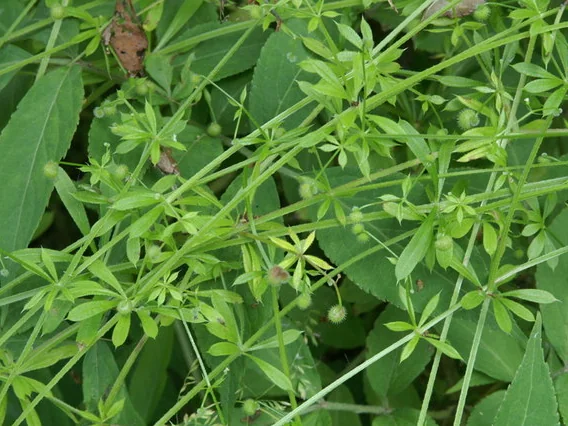
Cleavers grows in hedgerows, woodland edges, gardens, fields, path sides and waste ground.
Its long square stems carry whorls of narrow leaves. Almost the entire plant is covered with tiny backward-facing hooks.
Those hooks allow the weak stems to scramble through surrounding vegetation rather than having to support themselves.
Later, the plant produces small paired round seeds which are also covered in hooks.
The young plant as a vegetable
Very young shoot tips are edible, preferably cooked.
The problem is texture rather than toxicity: as the plant matures, those hooks and fibres make it increasingly unpleasant.
Pick only fresh, soft tips before the plant becomes coarse and seed-laden. Cooking softens the hooks.
The flavour is green, slightly bitter and fairly unremarkable — which might sound like faint praise, but the point is that this is an extraordinarily common free spring vegetable.
The really interesting use: wild “coffee”
Cleavers belongs to the Rubiaceae, the same botanical family as coffee.
When the little round seeds mature and turn brown, they can be gathered, cleaned, roasted and ground to produce a coffee-like drink.
It won’t make Starbucks nervous. But as a demonstration of what can be made from a common hedge weed, it’s fantastic.
Forgotten use
Cleaver-seed coffee
- Collect fully mature, dry brown seeds.
- Separate them from as much stalk and leaf material as possible.
- Spread them on a baking tray.
- Roast at approximately 180°C / 160°C fan, watching closely, until they are thoroughly dried, darkened and give off a roasted aroma. Moisture and quantity will affect the time.
- Cool completely.
- Grind using a sturdy coffee or spice grinder.
- Steep approximately a tablespoon of ground seed in a mug of hot water, then filter it.
The result is considerably milder than real coffee: more of a roasted, earthy drink than an espresso replacement.
The seeds are extremely hard when mature, so don’t try chewing them whole.
Warning
The hooked hairs can irritate sensitive skin and make mature plants unpleasant to handle.
The young green plant is much nicer cooked than eaten as a hairy raw salad.
For the seed drink, use completely mature brown seeds rather than green developing fruits.