
Where to find it
If someone walks through the British countryside regularly, they have almost certainly walked past hawthorn thousands of times.
It is one of the classic plants of the British hedgerow and was extensively planted to form field boundaries. It also occurs at woodland edges, on scrubland, waste ground and in urban planting.
Hawthorn can grow as a small tree, but repeated cutting creates the dense, thorny hedge familiar across Britain.
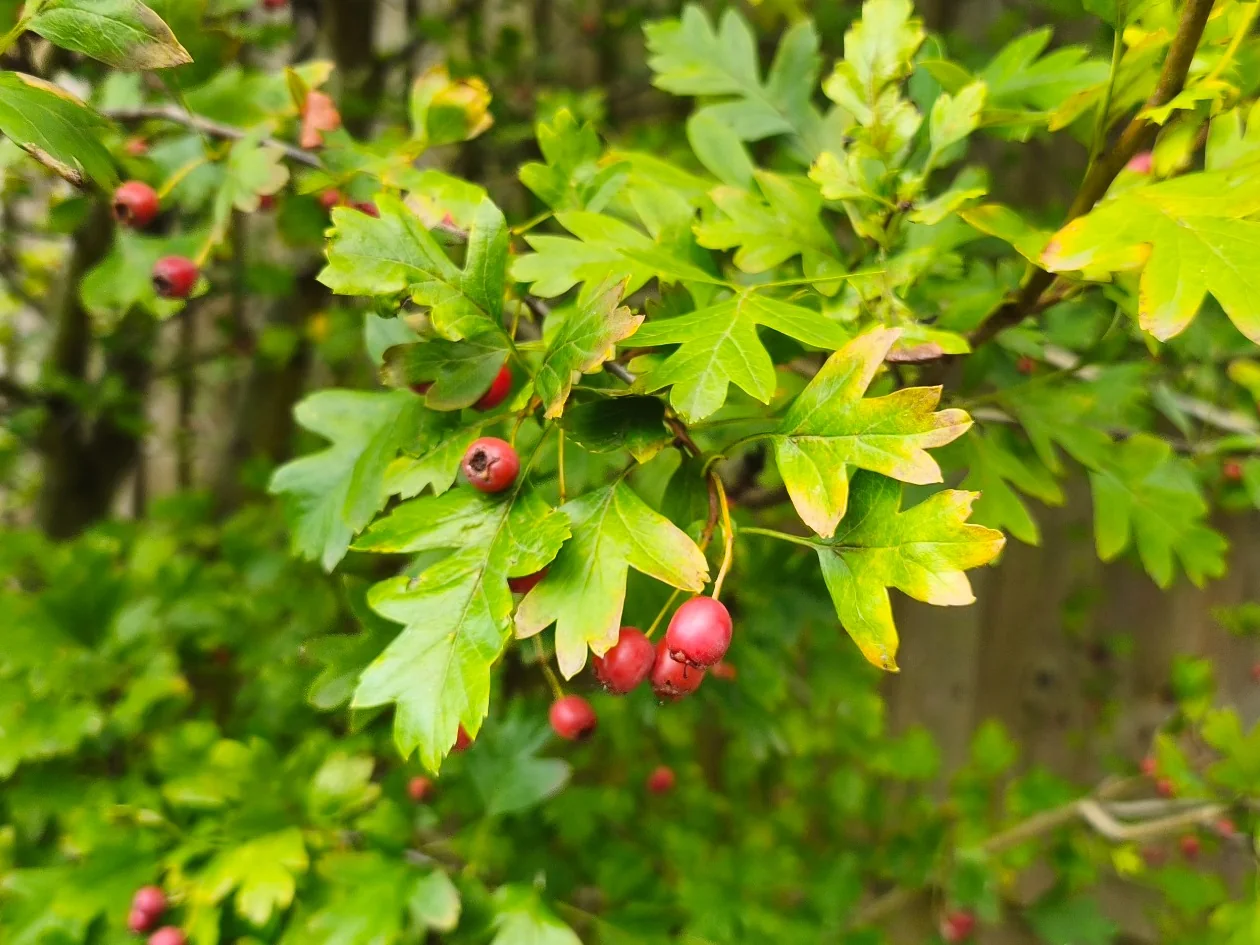
Its leaves are deeply lobed. White five-petalled flowers appear in abundance in spring, followed later by masses of small red fruits called haws.
The spring food: “bread and cheese”
Young hawthorn leaves have traditionally been nicknamed bread and cheese.
They were a familiar nibble for country children and can be eaten raw when very young and tender.
The name oversells them slightly — don’t expect something that tastes mysteriously like a cheese sandwich growing on a hedge — but the tender young leaves are mild enough to add to salad.
Young flower buds and very young flowers are also edible.
The autumn food: haws
The red fruits ripen later in the year.
Raw haws are technically edible, but their texture is rather dry and mealy and they contain a substantial hard stone. They are far more useful cooked.
Because haws contain plenty of pectin, they are particularly suitable for jellies and preserves. They can also make sauces, fruit leather, vinegar and ketchup.
Preserving the hedge
Hawthorn ketchup
A particularly good way to demonstrate that an ordinary hedge can provide real food.
For a modest batch
- 500 g ripe red haws
- 350 ml cider vinegar
- 350 ml water
- 150 g soft brown sugar
- Salt and pepper
- Optional pinch of chilli, cayenne or mixed spice
Remove stalks and discard damaged fruit. Wash the haws and simmer them with the vinegar and water until thoroughly soft.
Push the cooked mixture through a fine sieve or food mill. This separates the useful pulp from the hard stones and skins.
Return the pulp to the pan, add the sugar and seasoning, and simmer gently until it reaches approximately the consistency of tomato ketchup. Bottle into properly sterilised containers.
Warning
Hawthorn branches carry sharp thorns, so reach into a hedge carefully.
Do not simply chew through whole haws. The fruit contains a large hard stone; processing through a sieve is much more sensible.
Do not encourage readers to gorge on raw haws. They are far better used cooked.
And make certain the plant really is hawthorn before eating from an unfamiliar hedge.