
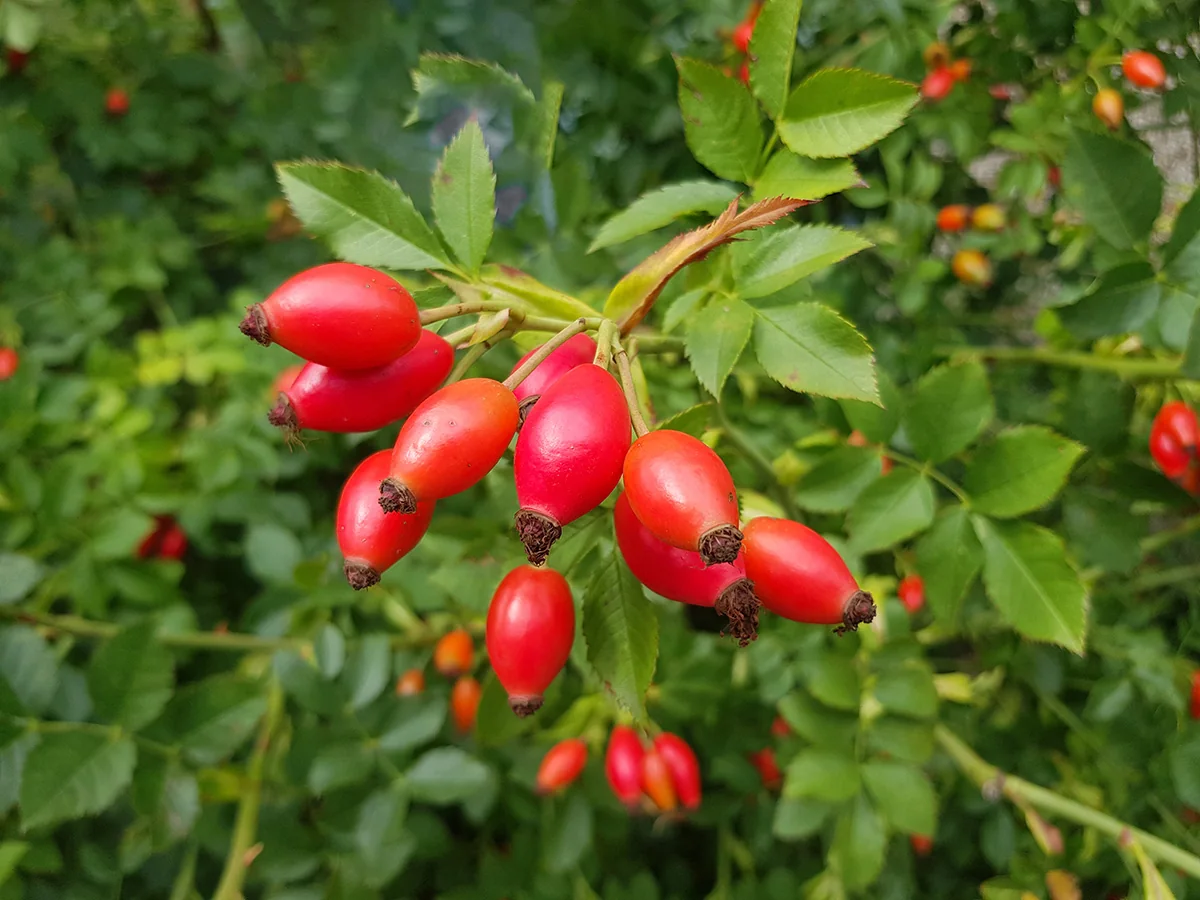
Where to find them
Dog rose is common in hedgerows, scrub, woodland edges and copses throughout Britain.
It is a scrambling, thorny rose producing attractive pink-white flowers in early summer followed by oval red-orange fruits — the hips.
Other roses also produce hips. Rugosa rose, often planted in coastal or urban hedging, produces particularly large fruits.
Dog rose hips generally ripen in September and October.
Why rosehips matter historically
This one comes with a wonderful piece of relatively recent British history.
During the Second World War, imported citrus fruit became difficult to obtain. Rosehips were recognised as an exceptionally rich source of vitamin C, and organised collection schemes encouraged British children and community groups to gather them for commercial syrup production.
A national collection effort in 1941 gathered around 200 tons of hips, ultimately producing roughly 600,000 bottles of rosehip syrup.
So this isn’t merely “something wild you can eat”. Within living historical memory, Britain’s hedges genuinely supplemented the national food supply.
What can be eaten?
The fleshy red outer part can be made into syrup, jelly, jam, fruit leather, cordial and tea.
The problem lies inside.
Rosehips contain numerous seeds surrounded by fine irritating hairs. Those hairs were famously associated with old-fashioned itching powder and should not end up in food.
For syrup and jelly, careful fine straining is therefore essential.
Traditional preparation
Rosehip syrup
- Wash the hips and remove obvious debris.
- Roughly chop or crush them.
- Simmer them in water until thoroughly softened and their flavour and colour have infused into the liquid.
- Strain very carefully through a jelly bag or double layer of fine muslin to remove the hairs.
- For extra reassurance, strain the liquid a second time through clean fine material.
- Measure the strained liquid, add sugar and gently heat until dissolved.
- Bottle hot into properly sterilised bottles.
Exact historic Ministry of Food formulas varied over time, so a verified historical formula is best treated separately from a modern home recipe.
Warning
The bushes are thorny.
More importantly, the hairs surrounding the seeds are irritant. Do not simply blend whole hips into something and consume the resulting pulp.
Filter carefully.
As with all preserves, clean equipment, correct sterilisation and sensible storage matter.