Where to find it
Sweet chestnut is a long-established tree in Britain and is particularly common in woods, old estates, parks and areas of former coppice, especially in southern England.
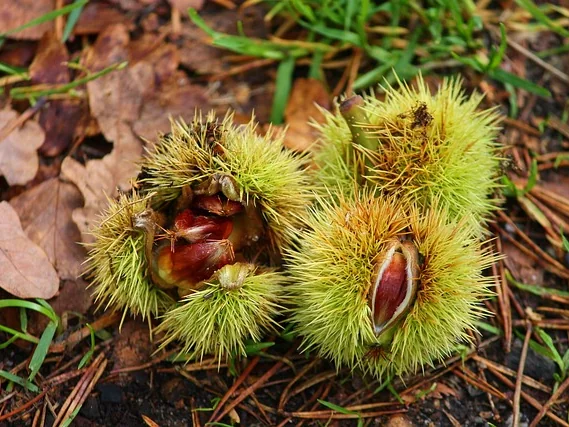
Mature trees can become enormous. The leaves are long, glossy and sharply toothed, quite unlike the hand-shaped leaves of horse chestnut. In summer the tree carries long yellowish catkins. By autumn the nuts develop inside densely packed green burrs covered in many fine spines.
The nuts themselves are glossy brown and usually have a distinct pointed end.
What can be eaten?
The mature nut inside the shell is edible.
Sweet chestnuts are unusual among nuts because they are much starchier and lower in fat than hazelnuts or walnuts. They can be roasted, boiled, mashed, added to soups and stuffings, used in cakes and puddings, or dried and ground into flour.
They are also notable nutritionally: sweet chestnuts provide vitamin C as well as B vitamins and minerals including potassium and magnesium.
The forgotten use: chestnut flour
For communities in parts of Europe, chestnuts were once far more than an autumn snack. Dried chestnuts could be stored and ground into flour, providing a useful source of carbohydrate long after the fresh harvest had finished.
Chestnut flour has a naturally sweet, nutty flavour. It contains no gluten, so it behaves differently from wheat flour, but it can be blended into pancakes, cakes, biscuits and breads.
Simple autumn food
Roasted sweet chestnuts
- Use mature, sound sweet chestnuts and discard any that are mouldy, badly damaged or unusually light and shrivelled.
- Wash and dry them.
- Cut a clear slit or cross through the shell of each nut before heating. This allows steam to escape.
- Roast on a tray at about 200°C / 180°C fan for roughly 20–30 minutes, depending on size, until the shells have opened and the nut inside is tender.
- Peel while still warm, removing both the hard outer shell and as much of the thin inner skin as practical.
Eat them warm, chop them into stuffing, or mash them with a little butter and seasoning.
How to recognise the right chestnut
This distinction matters enormously: sweet chestnut is not horse chestnut.
Sweet chestnut has long, single, glossy leaves with sharply toothed edges. Its edible nuts are held in extremely spiny burrs covered in many fine prickles, and the nuts usually have a pointed tip.
Horse chestnut has large hand-shaped leaves made up of several leaflets. Its familiar conkers sit inside a much less densely spined green case.
Warning
Do not eat horse chestnuts (conkers). They are not a substitute for sweet chestnuts.
If you are not completely certain that the tree and nuts are sweet chestnut (Castanea sativa), do not eat them.
The burrs are extremely prickly. Thick gloves or sturdy footwear can help open fallen burrs without filling your fingers with spines.
People with tree-nut allergies should treat chestnuts with appropriate caution.
Take only a reasonable share of fallen nuts and leave plenty for wildlife and natural regeneration.