Where to find it
Wild garlic is a spectacular spring woodland plant.
It thrives particularly in damp deciduous woods, shady hedges, stream sides and moist banks.
Where conditions suit it, thousands of plants can form a continuous green carpet beneath trees.
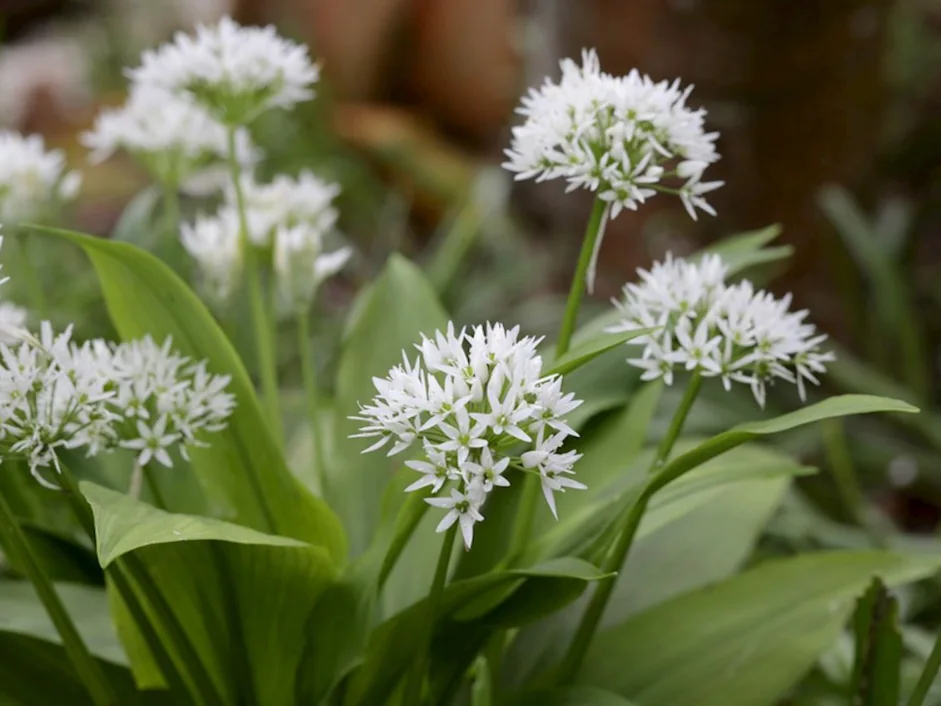
The leaves emerge from the ground individually. They are broad, smooth-edged and pointed, with a prominent central vein.
Later, stems carry clusters of small white six-petalled flowers.
And, of course, the entire patch often smells unmistakably of garlic.
What can be eaten?
Young leaves are excellent raw in small quantities and can be chopped through salads.
Cooking softens both their texture and garlic strength. Use them as a spinach-like vegetable, wilt them into pasta, add them to soup or stir them into scrambled eggs.
The flowers are edible and make an attractive garnish with a definite garlic flavour.
Wild-garlic pesto has become one of the classic modern British foraging recipes.
Spring recipe
Wild garlic pesto
- 100 g washed wild garlic leaves
- 50 g Parmesan or a suitable alternative
- 50 g toasted pine nuts, walnuts or hazelnuts
- Olive oil as required
- Lemon juice
- Salt and pepper
Blend the wild garlic, cheese and nuts. Gradually add enough oil to produce the consistency you want. Season with lemon, salt and pepper.
Important warning: poisonous lookalikes
Wild garlic deserves a much stronger identification warning than blackberries or nettles. It can grow alongside plants that are not edible.
Among the important ones are lily-of-the-valley and lords-and-ladies / cuckoo-pint.
Lily-of-the-valley is poisonous and contains cardiac glycosides. Its leaves can superficially resemble wild garlic before flowering.
Lords-and-ladies frequently grows among wild garlic in the same damp woodland environment. Its tissues contain calcium oxalate crystals capable of causing severe mouth and throat irritation.
Do not grab handfuls indiscriminately from a carpet of wild garlic.
- Pick leaves individually.
- Check their shape.
- Confirm the garlic scent from the individual leaf.
- Do not assume that because your hands already smell of garlic, everything else you have picked must also be garlic.
- Look through your collection again while washing it.
Harvesting responsibly
Take leaves, not the underground parts.
A large healthy colony can tolerate careful leaf harvesting far better than people digging plants out.
Leave plenty of plants untouched and avoid trampling the colony while gathering.