Where to find them
Hazel is native and widespread in Britain.
It grows in deciduous woodland, hedgerows, scrub, woodland edges and old coppices.
For centuries it was a tremendously useful plant because cutting hazel down to its base causes it to produce masses of long, straight new stems. This coppicing cycle provided poles and woven material while allowing the plant to live for a very long time.
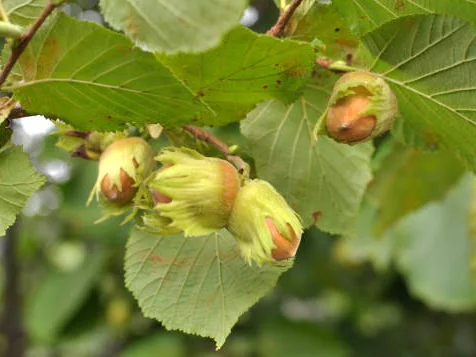
The leaves are rounded, softly hairy and toothed around the edge. In winter, male flowers appear as long yellow “lamb’s-tail” catkins.
Nuts develop inside leafy husks during summer and ripen towards autumn.
The biggest challenge: beating the squirrels
Wild hazelnuts can be surprisingly difficult to gather ripe because squirrels, mice and birds know exactly where they are and have rather fewer diary commitments than we do.
Mature nuts turn brown and the papery husk begins pulling away. Green nuts can also be gathered and allowed to finish ripening somewhere warm, dry and dark.
What can be eaten?
The kernel inside the hard shell.
Once properly mature, hazelnuts can be eaten raw or roasted.
They can also be ground into meal or flour, added to bread and cakes, mixed into porridge, made into nut butter or chopped into savoury dishes.
Of all the plants in this guide, hazel arguably provides one of the most calorie-dense genuinely wild foods.
Simple wild-food recipe
Roasted hazelnut butter
- Shell enough mature hazelnuts to produce a couple of good handfuls of kernels.
- Roast them on a tray until fragrant and lightly coloured.
- Allow them to cool slightly.
- Rub away loose papery skins if desired.
- Put the nuts into a powerful food processor.
- Blend. At first they become crumbs, then a dry-looking powder, and eventually the natural oils release and the mixture turns into nut butter.
- Add a small pinch of salt. A little sugar or cinnamon is optional.
Warning
Nut allergy is the obvious serious concern.
Discard nuts with holes, mould, shrivelled interiors or unpleasant/rancid smells.
Do not strip an entire tree. Hazel nuts are valuable food for wildlife and natural regeneration.